
 +91 92118 40803
 What Should You Know Before Going on a Solo Trip?
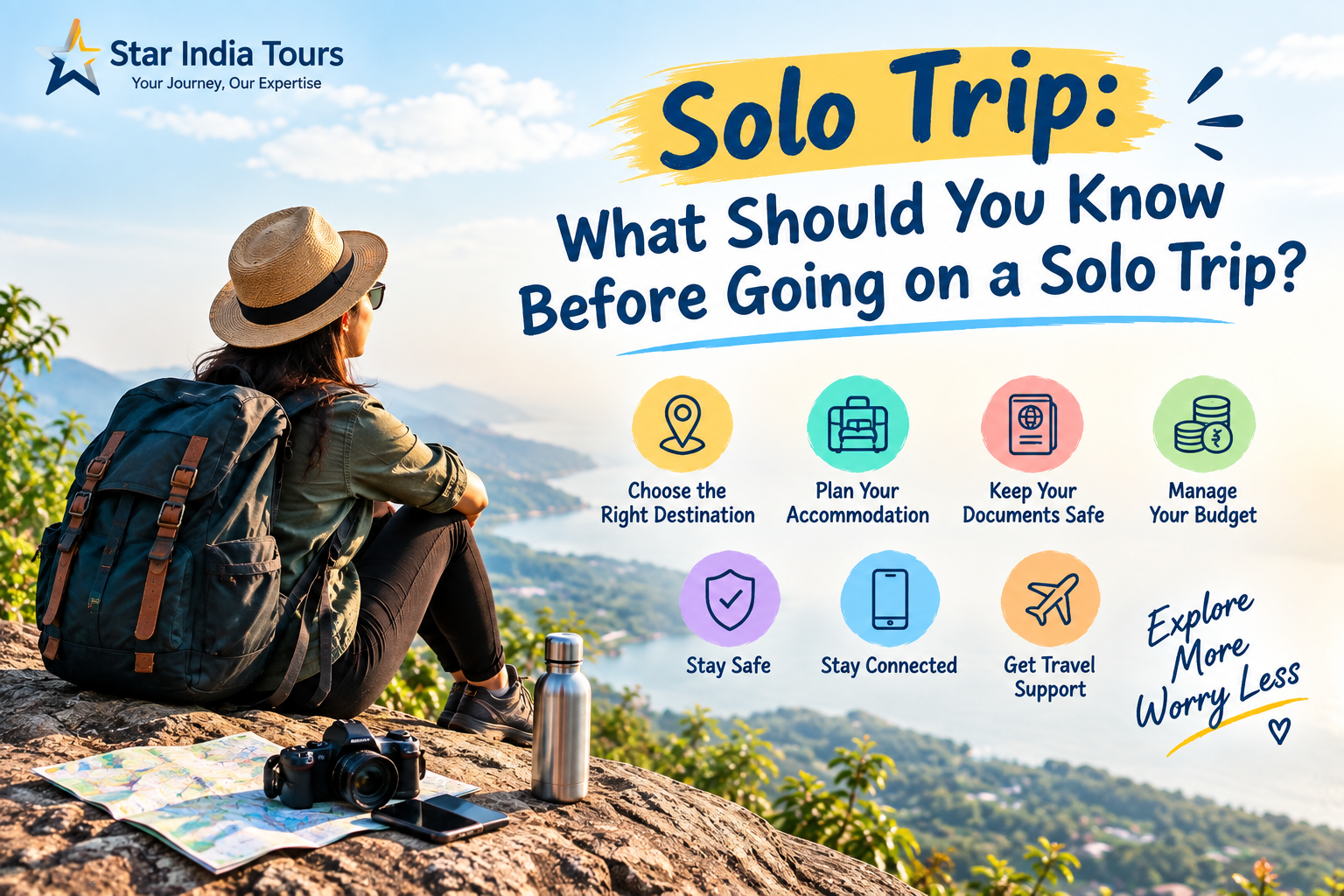
Taking a Solo Trip gives you the chance to visit your dream destinations and has the added benefits of personal choice and pacing when you travel. It also requires you think a little more in advance about your travel plans. Since you alone control your safety and your plans, the details like your destination and accommodation, your contacts, and your travel budget also become your responsibility. It sounds like a lot of work, but with the right planning, a solo trip can be just as comfortable and enjoyable and, more importantly, full of experiences you will cherish.
What Should You Know Before Going on a Solo Trip?
Traveling solo makes you responsible for all of the details of your trip, but it also offers a level of flexibility you won’t ever experience traveling in a group. You can choose how long you want to spend in each location and even how long you want to sleep in the morning. You can even choose to abandon your plans for the day if you want.
Flexibility also has its drawbacks. You alone are responsible for your plans, your things, and, most importantly, your safety.
Flexibility also has its drawbacks. You alone are responsible for your plans, your things, and, most importantly, your safety.
Preparing for a trip is especially important for solo trip. Planning beyond the basics, like learning about your destination, the local transportation, the customs, the expected weather, and a rough itinerary, can go a long way toward eliminating stress about the unknown.
There is no reason for planning to make your trip less enjoyable. The planning is more about relieving stress so you can enjoy your trip.
It provides a dependable system for you while giving you sufficient flexibility to wander beyond the borders of the system.
How Should You Identify the Most Suitable Travel Destination?
Your travel destination is one of the most important factors of your trip. First time traveling alone requires you to be mindful of travel destinations that have easy to follow routes and have available resources for transportation and lodging.
There are several travel destination variables to think of when you are looking to finalize and select a travel destination. They are as follows:
- Safety of travelers in the area
- Forecast for the trip having to do with the weather
- Availability of travel infrastructure
- Proximity of the travel destination to the points of interest
- Borrowing a phrase, “the ability to communicate” and the local language
- Resources for lodging
- The local way of life
- Services for health and safety emergencies
- The price of traveling to the destination and being there.
A travel destination that has a lot of social media appeal is not always the best travel destination for people traveling on their own. Take the time to look beyond the social media appeal and do your own research.
While social media offers inspiration for trips, it is important to travel to locations that have the things you want to do. For example, do you want to be in a culturally rich urban area that is constantly buzzing with activity? Or do you want to be in a remote area surrounded by nature?
The travel destination for your Solo Trip should be one that has your interests at the same time being in a safe and secure area as that will help create a great travel experience.
What Should You Know About Your Travel Destination Before You Leave?
After you pick a travel destination, you have to do some research on how it works. You should find out where most tourists stay and what the best mode of travel to get to the points of interest is and how far they are from each other.
Make sure you check the weather before you leave to avoid packing things that you will not need.
Changes in climactic conditions will affect your decisions on your choice of clothing and footwear, your reliance on alternative forms of transport, and your options for activities beyond the confines of your accommodation.
It’s worth checking local guidelines on behavior and dress codes, as well as guidelines for photography and tipping, as they differ in each location.
Prior to departing, save important local sites to your phone. Local sites of importance may be your accommodation, places to catch a train or flight, the hospital, pharmacy, police station, and a hub of transport services.
Learn basic words of the language. Local words for basic greetings, asking for directions, ordering food, and requests for help will aid communication, and are a good first step.
How Do You Plan Your Accommodation Safely?
In a location you are unfamiliar with, find accommodation with a good rating, in a secure area, and with transport close by.
Don’t choose an accommodation with the lowest price if that means sacrificing other important features. Look at the area’s safety, the accommodation’s check-in and check-out rules, and reviews left by guests.
Look at the accommodation’s:
- Location
- Check-in and check-out timings
- Safety features
- Distance to transport
- Area amenities (food, shopping)
- Cancellation policy
- Reviews
- Contact info
Accommodation that allows for a late check-in is a must if you plan to arrive at your destination late. This will prevent stress after a long journey.
Keeping your accommodation address saved on your phone is important when traveling alone. In the event your phone loses connectivity, you will still be able to access important information.
What Travel Documents Should You Carry?
The price of having your important travel documents in an organized system is the peace of mind it provides you when you travel alone.
Your travel folder will vary by destination. Consider including the following in your travel folder:
- Founded ID
- Passport
- Visa
- Flight/Train Tickets
- Hotel Reservations
- Travel Insurance
- Driving License
- Emergency Contacts
Consider using a digital storage safe to keep your important documents secure, then use printed copies, and keep them away from the originals.
Use different storage methods for your travel documents. It will help expedite the process of verification or replacement when your documents are lost, and you have the copies stored elsewhere.
Check the requirements of your destination countries for the validity of your passport and visas early on before you book a trip. Each country has a different policy, so always check the country’s official site to find the up to date information.
How Can You Manage Money During a solo trip?
Digital conveniences have made payments much easier. Even though this is the case, do not limit your travel payments to just digital payments.
Have access to multiple payment methods, and carry a reasonable amount of cash in a hidden emergency wallet.
Consider the following expenses before you travel:
- Your daily expenses
- Accommodations
- Transport
- Food/Sightseeing
- Emergency funds
- International cash withdrawal fees, if applicable
Never carry cash in public. While traveling, ensure the ATM you are using is safe, secure, and well known.
During a Solo Trip, keeping track of your finances is important, since you are the only one that will monitor the expenses.
Why Should You Share Your Itinerary With Someone?
Traveling independently doesn’t meant traveling alone. Share your travel plans with friends or family members before you set off.
Write down:
- Where you’re going
- Where you’re staying
- Where you’ll be traveling to
- How long you’ll be gone
- What you’ll be doing
- Who to contact in an emergency
You don’t need to let them know about everything you’re doing. Checking in every once in a while will ease some nerves.
Let your contact know if your plans change a lot. For example, if you choose to spend the night in a different city rather than going back to where you were staying, let someone know.
This is a good habit to get into in case something out of the ordinary happens.
Packing Tips for a One-Person Getaway
Smaller bags make for faster, more independent trips. You’ll have to carry and organize everything you have, making packing light a must for easy travel.
Think of where you’re going and what you’ll be doing there. It may seem counterintuitive, but packing with the possibility of reusing and rearranging items helps to reduce the amount of things you have to carry.
Some useful essentials include:
- Good shoes
- Proper clothing
- Hygiene products
- Any personal medicine
- Phone with charger and a power bank
- All travel electronics you use with an outlet
- A clean empty, reusable water bottle
- A small kit to take care of minor injuries
- Copies of necessary papers
- A good bag that helps you organize what you need
The size of the bag should balance providing enough space for all the essentials while also making sure it’s compact enough to be easy to carry day to day. Creating balance like this is an essential part of the art of solo travel.
When traveling solo, the number of things you bring should be as little as you feel is necessary given that you alone will be responsible for managing everything. Minimizing your load will help you manage the logistics of traveling much more efficiently and easily.
What Is The Best Tech to Take on a Solo Trip?
When it comes to travel tech, your phone is likely the most important piece of tech to travel with. Your phone will help you with navigation, communication, reservations, translation, payments, and even helping you call for help in an emergency.
Don’t forget to download any necessary information, documents, or maps that you may need but won’t be able to access when you are offline. To help ensure your phone is usable while you are out traveling for hours each day, bring a power bank with you out for the day.
If you are traveling to another country, obtain information on the connectivity options for your phone before leaving. Your destination may require an International SIM or eSIM, or a traveling plan with International roaming.
Be sure to store the numbers for your lodging, local emergency services, your travel provider, and someone at home you can trust in an easily accessible location.
Don’t only rely on your phone and the Internet for connections. Having offline copies of reservations and maps will prove extremely valuable when and if your connection becomes unreliable.
What Are the Safest Habits for a Solo Traveler?
The best attitude to adopt when traveling independently is awareness. This is especially important to practice when you arrive in a new place and are moving through crowded spaces.
Don’t tell strangers your lodging, itinerary, or financial info. There is no need to freely give this information when it is not asked for.
Keep to the main and the bright streets when traveling solo at night.
If you feel anything other than confident about the place you will be traveling, use safe transportation options as opposed to taking reckless chances.
Be careful with cheap offers, odd requests for favors, or free gifts. If you feel even slightly suspicious about a situation, it’s your right to leave.
During your Solo Trip you will find that your instincts will be important, perhaps more than the things you have planned.
What Should You Know About Local Transportation?
Knowing the means of local transportation will help you to budget and plan better. Familiarize yourself with the availability of buses, trains, metros, taxis, convenient rides, etc.
Once you know the means of transportation, find the average time it takes to travel from your accommodation to the sights and nearby attractions. This will help you plan your daily itinerary.
If you have chosen to rent a vehicle, be aware of all the terms and anything related to local insurance, road conditions, and the rules for driving and parking.
Never hitchhike if there are proper means of transportation available to you.
Plan for your transportation from the airport with special consideration if your flight lands after dark. Knowing how you will get to your accommodation will relieve some of the stress you may feel when arriving in a new place.
How Can You Handle Emergencies During a Solo Vacation?
Unplanned things happen no matter how much you try to prepare. You may feel sick, your baggage may be lost or delayed, and maybe your transportation showed up and your reservation did not.
The goal should be to plan for the most likely things that happen without obsessing over the unforeseen.
Know your local and international emergency contact numbers and save them in your phone.
Be sure to take any needed medications, and don’t forget to get travel insurance when applicable.
You can avoid relying only on your phone by either memorizing or housing the essential information somewhere safe.
Know the location of the nearest medical institution and/or hospital. This is extremely important to know when going to new and far locations or when participating in activities like camping or hiking.
Not every situation is in your control, but with a little preparation and remaining calm, the tension of the unknown becomes significantly less stressful.
How Can Star India Tours Assist You for solo trip?
Planning your own holiday means that you get to pick how you spend your time, but the holiday doesn’t need to be a completely solo effort. Star India Tours is at your service whether you need help picking your location, building your itinerary, or even just booking the experienced services offered.
This is also a great option to have when dealing with several different locations on your itinerary or when you are new to the area you are visiting.
Star India Tours also offers services to the travelers who are are going to plan the majority of their trip, but would like to have services offered to help during the planning.
When you want to book an independent trip, you assume the burden and the control to customize your travel experience.
There is always a positive impact of engaging a travel expert to support you with an independent travel plan.
What is the most important rule when taking an independent holiday?
You have to spend time researching the destination first. Ensure you get familiar with the local customs, the modes of transport, the kind of weather you can expect to find there, and most importantly, the availability and location of essential services there.
Inform someone of your plans
Let your friend or family member know the hotel you will be staying in.
Secure your important papers
Make sure your important documents are safe and keep a copy of the documents safe too either through an online copy or physical copy.
Have alternative payment methods
Ensure you have cash as a payment option.
Travel light
Travel light, carry what is necessary.
Have a good sense of what’s around you.
Keep an eye on your surroundings especially when you are in new and/or crowded places.
Keep your phone charged
Keep your phone charging device with you.
Be a good Judge of Your Surroundings
If you feel something is not right, leave that place.
Don’t Plan Every Moment
Make sure your plans for any given day are not too strict, be flexible.
Incorporate these habits to make your roads more enjoyable,
What Other Things Can You Do Without Putting Yourself At Risk?
Your preparation has been instrumental in making your trip an enjoyable one.
Go ahead and explore the local places of Interest, eat local, mingle with the locals, if time permits.
Solo trips enable travelers to gauge their degree of ruggedness. You will realize how you have come to love and appreciate comfort zones. You will be surprised at how adept you have come in solving unexpected challenges in unfamiliar environments.
Be sure to take breaks, enjoy the journey, and don’t cage yourself into a schedule.
It’s not a goal of your trip to tick off as many must see places in that travel guide.
A satisfying trip is not measured by the number of things crossed off a must-see list. It is measured by how satisfying your trip was in a new environment.
Happy traveling.
FAQS
1. Is it better to book the lodging in advance?
I think most people would agree that it relieves anxiety to book lodging in advance. It is a guarantee that gets you to relaxing on your trip that much quicker.
2. Does traveling solo cost more?
Generally, no. You lose the ability to share the costs of accommodations and transportation with a travel buddy, but the overall cost is easily manageable with the right amount of trip planning.
3. How can I avoid getting lost?
Before navigating somewhere you’ve never been, take the time to prepare. Get to know how to get around, pull up maps and transportation sys temps, keep the lodging bookmarked on a map, and know the transportation system.
4. Can I ask locals for help?
You can ask locals for help, however don’t harass people. Target the right places and ask the hotel staff, the information center, or the guard on duty for help.
5. Can Star India Tours assist in holiday planning?
Yes. Star India Tours helps travelers who need assistance with holiday planning such as destination planning, itinerary planning, and travel planning.
Final Thoughts
Solo trip is great for adventurers because it provides a durable self confidence of being able to self plan and self pace a trip. It is a great way to discover the world.
Independence is a good thing, but you have to be prepared, use good judgment, and be smart about the destination, lodging, document protection, finance, communications, and travel safety.
The aim is to be prepared, but not completely planned – that way you avoid robotic travel and traveling has spontaneous benefits, and you learn to balance the boundary between obstacles encountered and enjoy the adventures you planned.
With the right travel planning help, you are able to design and plan your adventures your way so they are memorable, safe and nice.